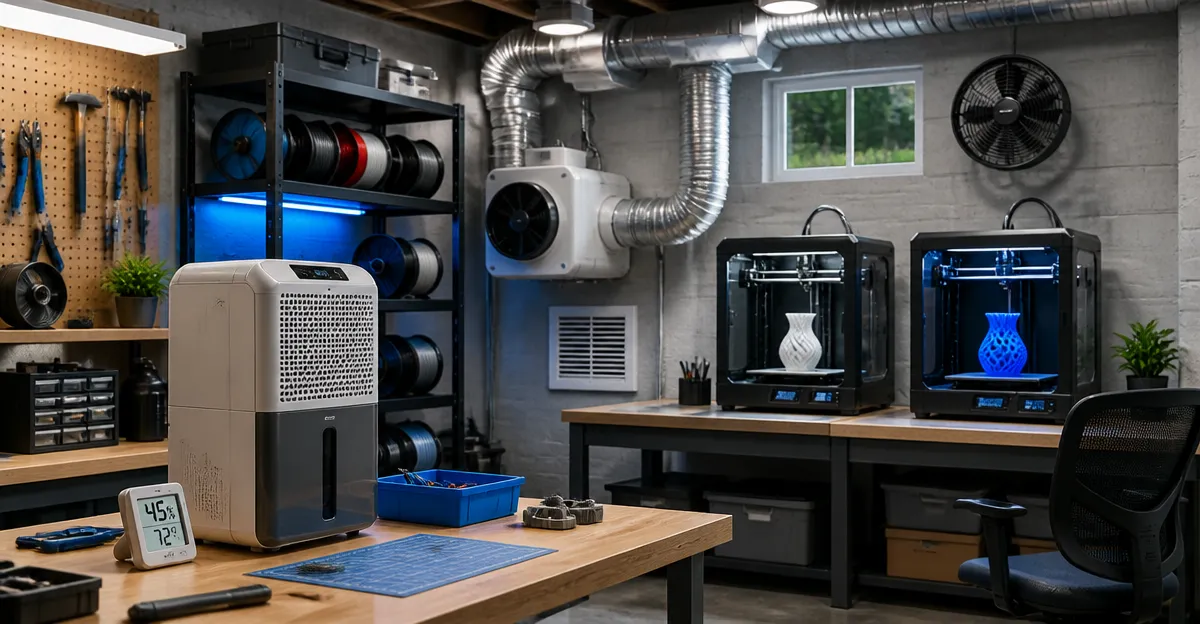
Introduction
This guide explains how to create an effective dehumidification and ventilation system for a basement makerspace that houses multiple 3D printers. Readers will learn the physics of moisture control, how to size fans and dehumidifiers, and which commercially available products provide the best balance of performance, energy efficiency, and durability.
Background / Context
3D printers generate heat and emit volatile organic compounds (VOCs) that can raise humidity and temperature in confined spaces. Excess moisture encourages filament degradation, metal corrosion, and mold growth, all of which reduce print quality and equipment lifespan. A well‑designed airflow network removes hot, humid air while a high‑capacity dehumidifier extracts moisture from the remaining air volume.
Key concepts include:
- Air changes per hour (ACH) – the number of times the total air volume is replaced each hour.
- CFM (cubic feet per minute) – a measure of fan airflow; higher CFM yields higher ACH.
- Capacity of a dehumidifier – expressed in pints per day; larger spaces require higher capacity.
- Energy Star and UL certifications – indicators of safety, efficiency, and compliance with industry standards.
Ventilation Fundamentals
Effective ventilation begins with a reliable exhaust fan. The iLIVING Shutter Exhaust Fan provides 960 CFM, a 12‑inch steel blade, and automatic shutters that close when the fan stops. Its variable‑speed Thermospeed controller allows temperature‑based cycling, which is ideal for a makerspace where heat spikes occur during long print runs.
Because the fan is wall‑mounted, it can be positioned near the ceiling to capture warm air that rises from the printer enclosure. The built‑in thermostat can be set between 32 °F and 130 °F, ensuring the fan runs only when temperatures exceed a chosen threshold, thereby saving energy.
When additional localized airflow is required—such as in a filament drying cabinet—supplemental inline fans are useful. The VIVOSUN 4" Inline Fan delivers up to 130 CFM at only 26 dB, making it quiet enough for a shared workspace while still providing enough pressure to move air through ductwork or a grow‑tent‑style enclosure.
Dehumidification Basics
Basement humidity often exceeds 60 % RH, especially in spring and summer. A dehumidifier rated for 80 pints per day can remove roughly 0.5 gallon of water per hour under worst‑case conditions (95 °F, 95 % RH). Selecting a unit that matches the square‑footage of the space is essential.
Three top‑rated 80‑pint models are available:
- AEOCKY 80‑Pint Dehumidifier – ENERGY STAR Most Efficient 2025, low‑temperature operation, 44 dB minimum noise.
- KNKA 80‑Pint Dehumidifier – 40–45 dB operation, built‑in 1.45 gal tank, optional external tank, smart humidity controls.
- Waykar 80‑Pint Dehumidifier – 42 dB operation, 30 %–80 % humidity range, AI‑smart protection, 4.3 L tank.
All three units carry ENERGY STAR certification, indicating they meet strict efficiency standards. The AEOCKY model distinguishes itself with a proprietary rotary compressor that reduces internal space and delivers the quietest low‑speed operation (44 dB). The KNKA unit offers a convenient 12‑hour timer and a washable filter, while Waykar provides AI‑driven frost detection for reliable performance in cooler basements.
Integrating Exhaust Fans and Dehumidifiers
To achieve optimal conditions, combine the iLIVING Shutter Exhaust Fan with one of the 80‑pint dehumidifiers. The fan removes heat and VOC‑laden air, while the dehumidifier extracts moisture from the remaining air volume. A typical layout includes:
- Place the exhaust fan on an exterior wall, positioned at least 6 inches above the floor to avoid drawing in dust.
- Install the VIVOSUN Inline Fan in a duct that routes fresh air from a low‑humidity zone (e.g., a hallway) into the makerspace.
- Position the dehumidifier centrally, ensuring at least 12 inches of clearance on all sides for airflow.
- Connect the dehumidifier’s drain hose to a floor drain or a condensate pump for continuous operation.
By coordinating fan speed with dehumidifier humidity setpoint, the system can maintain a stable 45 %–55 % RH, which is ideal for most filament types.
Comparison / Selection Guide
| Feature | AEOCKY | KNKA | Waykar |
|---|---|---|---|
| Price (USD) | 249.99 | 179.99 | 249.99 |
| Noise (dB) | 44 (low) – 50 (high) | 40–45 | 42 |
| Coverage (sq.ft.) | 5,500 | 5,500 | 5,000 |
| Energy Star | Most Efficient 2025 | Certified | Certified |
| Low‑Temp Performance | Operates down to 65 °F | Standard | AI‑smart defrost |
| Warranty | 3 years | 2 years | 2 years (plus 1 year registration) |
| Customer Rating | 4.5/5 (6,876 reviews) | 4.5/5 (1,136 reviews) | 4.3/5 (22,572 reviews) |
For a budget‑conscious maker who values quiet operation, the KNKA unit offers the lowest price and acceptable noise levels. For a user who requires guaranteed low‑temperature performance and rapid support, the AEOCKY model’s 3‑year warranty and fast replacement service make it a compelling choice. Waykar provides AI‑driven frost protection, which is advantageous in colder basements.
Best Practices & Tips
- Calculate required ACH: (CFM × 60) ÷ room volume = ACH. Aim for at least 6 ACH in a printers‑heavy environment.
- Seal gaps around the exhaust fan with exterior‑grade caulk to prevent drafts and insect entry.
- Set the dehumidifier’s humidity setpoint to 45 %–50 % for filament stability; verify with a calibrated hygrometer.
- Use the fan’s variable‑speed control to match heat output; during idle periods, reduce speed to 30 % to save energy.
- Schedule regular filter cleaning on the dehumidifier (every 30 days) to maintain airflow and efficiency.
- Consider adding a carbon filter to the exhaust line if VOC odors become noticeable.
- Monitor energy consumption with a smart plug; many users report up to $30 monthly savings with ENERGY STAR units.
Frequently Asked Questions
- How many CFM are required for a 1,200 sq.ft. basement?
- For 6 ACH, a 1,200 sq.ft. space with an 8‑ft ceiling has a volume of 9,600 ft³. Required CFM = (6 × 9,600) ÷ 60 ≈ 960 CFM, which matches the capacity of the iLIVING Shutter Exhaust Fan.
- Can I run a dehumidifier and exhaust fan simultaneously?
- Yes. Running both devices together removes heat with the fan while the dehumidifier extracts moisture, preventing the fan from simply recirculating humid air.
- What is the advantage of a thermostat‑controlled fan?
- A thermostat‑controlled fan activates only when temperature exceeds the set point, reducing unnecessary runtime and electricity usage.
- Do I need a continuous drain for the dehumidifier?
- Continuous drainage eliminates the need to empty the internal tank. All three 80‑pint models include a drain hose; the KNKA also offers an optional larger external tank for extended operation.
- How often should I replace the filter in the dehumidifier?
- Filters should be inspected monthly and replaced or cleaned every 3–6 months, depending on dust load. The KNKA model features a washable filter for convenience.
- Is the VIVOSUN Inline Fan suitable for outdoor use?
- The VIVOSUN fan is rated for indoor environments. For outdoor installations, a weather‑proof housing is required.
Conclusion
Designing a reliable dehumidification and ventilation system for a basement makerspace involves understanding airflow dynamics, selecting appropriately sized fans, and choosing a dehumidifier that can handle the expected moisture load. By combining the iLIVING Shutter Exhaust Fan with a high‑efficiency 80‑pint dehumidifier such as the AEOCKY, KNKA, or Waykar model, makers can maintain stable temperature and humidity, protect sensitive equipment, and improve overall print quality. Following the best‑practice checklist ensures long‑term reliability and energy savings.
Products Featured in This Guide
iLIVING Shutter Exhaust Fan
Price: $68.98 | Rating: 4.6/5 (3,748 reviews)
Featured for its 960 CFM capacity, variable‑speed thermostat control, and industrial‑grade construction, making it ideal for exhausting hot, humid air from a basement printers area.
AEOCKY 80‑Pint Dehumidifier
Price: $249.99 | Rating: 4.5/5 (6,876 reviews)
Featured for its ENERGY STAR Most Efficient 2025 certification, low‑temperature operation, and industry‑leading warranty support.
KNKA 80‑Pint Dehumidifier
Price: $179.99 | Rating: 4.5/5 (1,136 reviews)
Featured for its quiet 40–45 dB operation, built‑in tank with optional external tank, and smart humidity controls that simplify daily use.
Waykar 80‑Pint Dehumidifier
Price: $249.99 | Rating: 4.3/5 (22,572 reviews)
Featured for its AI‑smart protection system, 30 %–80 % humidity range, and reliable performance in colder basements.
VIVOSUN 4\" Inline Fan
Price: $26.39 | Rating: 4.3/5 (6,331 reviews)
Featured for its compact size, 130 CFM airflow, and ultra‑quiet 26 dB operation, making it ideal for supplemental airflow in tight printer enclosures.